The gap is on the record
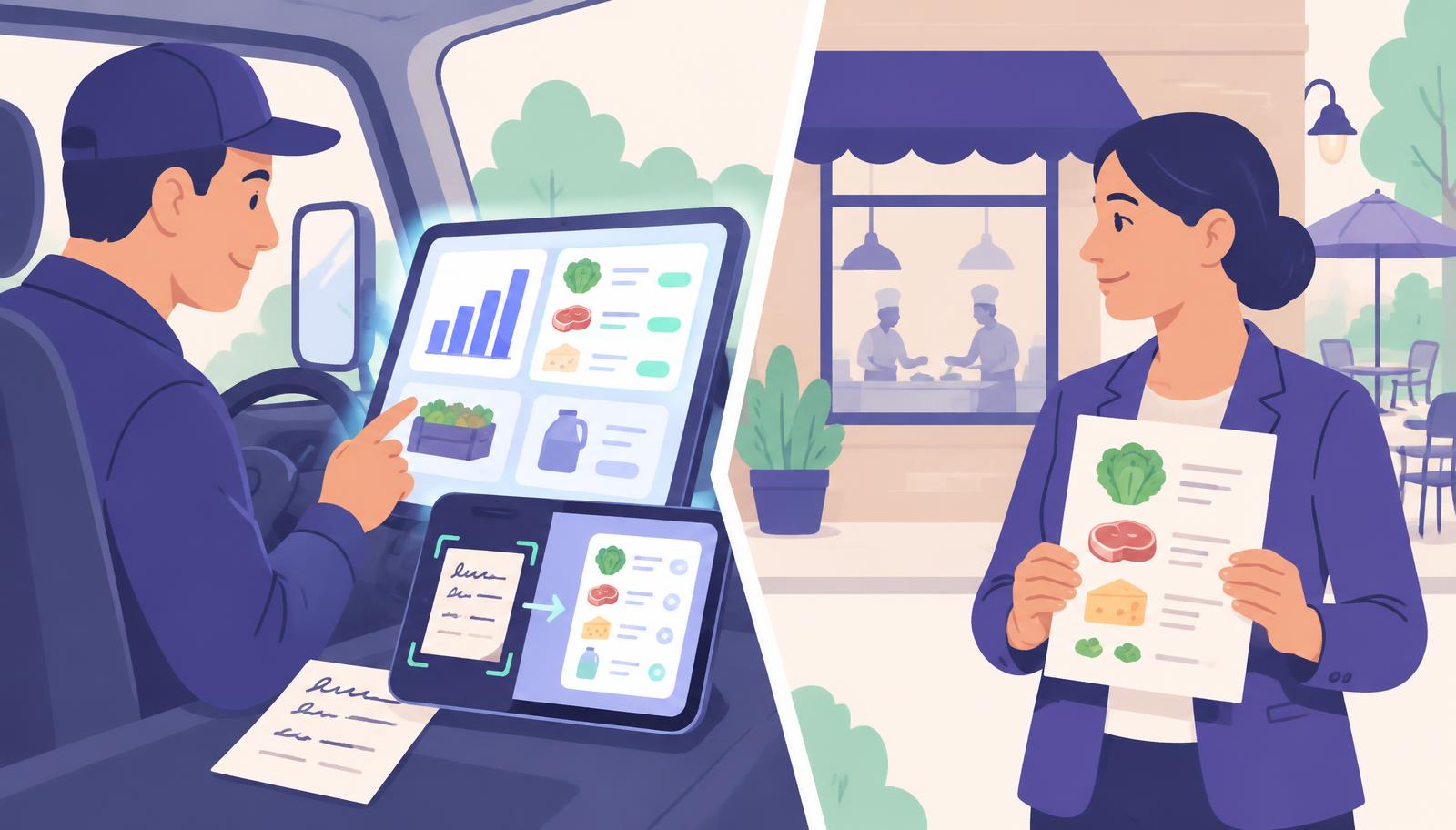
Sysco CEO Kevin Hourican told investors in January that AI360 had been live about four months and was used weekly by more than 95% of the sales organization. The tool analyzes purchasing patterns, suggests products to add, guides pricing, and can preauthorize deals. Sysco says the productivity gains are helping it take share while restaurant traffic stays under pressure.
US Foods now converts photos, PDFs and handwritten notes into digital orders. FMI found that more than two-thirds of food retailers use AI, up from 47% a year earlier.
Now look at the manufacturer side. Wherefour's 2026 report found 65% of food and beverage manufacturers don't use AI, 34% use it partially, and 1% report full adoption. Rootstock's survey says 94% of manufacturers use some form of AI.
Different samples, different definitions. Your board deck probably picked the loose one.
The front door moved
Operators now consult AI before they speak to a sales rep and before they visit your website. Only about a fifth of operators change suppliers each year, so a missed shortlist costs you a long wait.
Inside ordering platforms, search algorithms, categorization rules and promotional placements decide which items surface, often without transparent criteria. Australia's foodservice conference this year put a panel on AI systems that autonomously evaluate and execute purchasing, and what that means for suppliers trying to get listed.
The first meeting is happening without you. Thin item data loses it before anyone picks up a phone.
What the front edge looks like
Mondelez invested more than $40 million in a generative AI platform built with Publicis and Accenture. It expects to cut marketing content production costs by 30% to 50%. Nestlé rolled out NesGPT, its internal ChatGPT, across sales, marketing and legal.
Notice the pattern. Cost comes out of content and prep time comes out of selling. Nobody removed the person in the room.
Mid-market companies should copy the target, not the check.
The IT problem
Most companies hand AI to IT and call it governed.
Pearl Meyer's survey shows leaders can't agree on who owns it. 32% say the C-suite, 22% say the group one level below, 27% say individual business leaders, and 17% say functional heads. In CIO.com's 2026 survey, 24% of CIOs can't say which department owns AI ROI.
Info-Tech found that most organizations assign a CIO or CTO, and that model does not lead to the best results. Companies with a board-governed strategy were three times as likely to have measurable impact, 60% versus 20%.
MIT's NANDA study shows the failure side. 95% of organizations saw no measurable financial return despite an estimated $30 to $40 billion in spending. The winners tied projects to a specific workflow, measurable operating outcomes and accountable business owners.
IT can buy the tool. IT can't decide which distributor call to win.
How a CEO finds out in a week
Five checks. None need a consultant.
- Ask three AI assistants who solves your customer's biggest operating problem. Count how often your brand appears.
- Ask your top distributor rep what prompts them before a customer visit. Look for your product in it.
- Pull your item record at your two largest distributors. Count the empty fields.
- Ask marketing what share of last quarter's content a rep used in a customer meeting. Watch how long the answer takes.
- Name the person accountable for AI return in your commercial organization. If the answer is "IT," you have your answer.
Benefits, costs, risks
Benefits. Sysco shows where the return lands: rep productivity, order size and new customer wins. Mondelez shows the content side. The third benefit is the one nobody measures yet: showing up on the shortlist before a human is involved.
Costs. Mondelez's $40 million is a big-company price. The mid-market bill is data cleanup, workflow redesign and one accountable owner. MIT found that 60% of organizations evaluated AI tools, 20% reached pilot and 5% reached full production. Pilots are cheap. Production is where the money goes.
Risks. Pilot theater is the first. Brand damage is the second. Coca-Cola's AI-created holiday ads in 2024 drew criticism for lacking real emotion, and Mondelez says human oversight remains essential for everything its tool generates.
The third risk is automating volume. If AI cuts your content cost and your competitor's too, volume stops being an advantage. The fourth is waiting. Every quarter off the shortlist is a quarter a competitor sells into the account.
What this means for ownership
Private equity has the conviction and is short on the proof. Grant Thornton's 2026 survey found the sector is building conviction about AI faster than it is building measurable results. Alvarez & Marsal's European survey reports 63% of PE respondents now use AI in value creation, up from 41%, but only 39% use it across multiple functions and deliver measurable value.
StepStone found that nearly 40% of GPs don't expect material financial impact from AI in 2026. L.E.K. found that only 21% of PE professionals rate their own AI expertise as advanced or leading edge.
A buyer's diligence team will ask how your products show up where operators now search. A commercial engine running last decade's playbook gives them a discount argument.
What AI can't do
I led the 2018 foodservice launch at Impossible Foods, from about 400 to 5,000 restaurants. We built White Castle, Compass, Disney and The Cheesecake Factory as pipeline accounts. We seeded accounts that later became Burger King and Starbucks.
People did that work. A prompt didn't.
AI-native marketing automates the prep: finding the account, building the deck, pricing the deal, filling the item record. It frees your best people for the part that closes. Skip that and you pay a senior marketer to do what Sysco's reps get from software.
Who owns AI in your commercial organization today? A name, not a department.
Sources
Research run November 9, 2026. Search-result sources, not primary filings, unless noted.
- Digital Commerce 360; Storyboard18; Let’s Data Science: MIT NANDA: 95% no return; 5% to production View source
- Distribution Strategy Group: Sysco AI360 usage, features, share gains View source
- Distribution Strategy Group: Sysco fiscal Q3 2026 call View source
- Trendhunter (cites Digital Commerce 360): US Foods AI ordering View source
- ATDB: Food retailers’ AI use (FMI) View source
- Wherefour via Food Industry Executive: 65% / 34% / 1% manufacturer AI adoption View source
- Rootstock via Food Logistics: 94% of manufacturers use some AI View source
- Nation’s Restaurant News: Operators consult AI first; AI search View source
- Summary of NRN piece (Pulse): One-fifth of operators switch suppliers yearly View source
- Foodservice IP via Pulse: Platform algorithms decide which items surface View source
- FSAA Today & Tomorrow Conference: Agentic procurement panel View source
- Reuters via Mexico Business News; FoodBev: Mondelez $40M+, 30-50% cost cut, human oversight, Coca-Cola ads View source
- Food Industry Executive: Nestlé NesGPT View source
- Pearl Meyer survey via Fortune: Who owns AI: 32 / 22 / 27 / 17% View source
- CIO.com State of the CIO 2026 via BlueAlly: 24% of CIOs can’t name AI ROI owner View source
- Info-Tech AI Adoption and Impact Study: CIO-led AI; strategy triples impact (60% vs 20%) View source
- Let’s Data Science (MIT NANDA summary): Winners tie AI to workflows and owners View source
- Grant Thornton 2026 AI Impact Survey: PE conviction outpaces results View source
- Alvarez & Marsal (European survey) via Business Wire: 63% of PE use AI in value creation (up from 41%) View source
- StepStone Group: ~40% of GPs expect no material impact in 2026 View source
- L.E.K. PE Pulse 2026: 21% rate own AI expertise advanced View source